

Technical due diligence is often described as the search for what is wrong with a technology platform. That is only half the job. A good review also identifies the gaps and charts the path; the target state where technology needs to be for the investment to play out. The diligence report is a snapshot of state point in time, the roadmap on the other hand is what lives beyond the deal.
At Sahaj, we look at that roadmap through 16 areas, from Architecture to M&A Readiness. With the recent innovations, AI has caused a shift in all of them at once. It has moved the size of the investment, compressed the time windows and the available remediation options to technology teams. Functional coverage is not a moat anymore and it has also shifted where the risk sits. AI-native systems carry uncertainty in places diligence has not traditionally looked. The model behaviour at inference time, judgment embedded in the harness instead of the code, and key vendor dependencies that sit outside the codebase entirely and change rapidly. While the checklist that worked in 2020 is not completely irrelevant, it is worth recognizing that it was built for different failure modes than the ones that exist now.
Sixteen areas, one maturity scale
The 16 distinct areas are measured on a three-step scale: Foundational, Emerging or Leading. The scale keeps the conversation with management, and with the investment committee, short and comparable. Areas highlighted in blue below, are the ones where AI is changing things most.
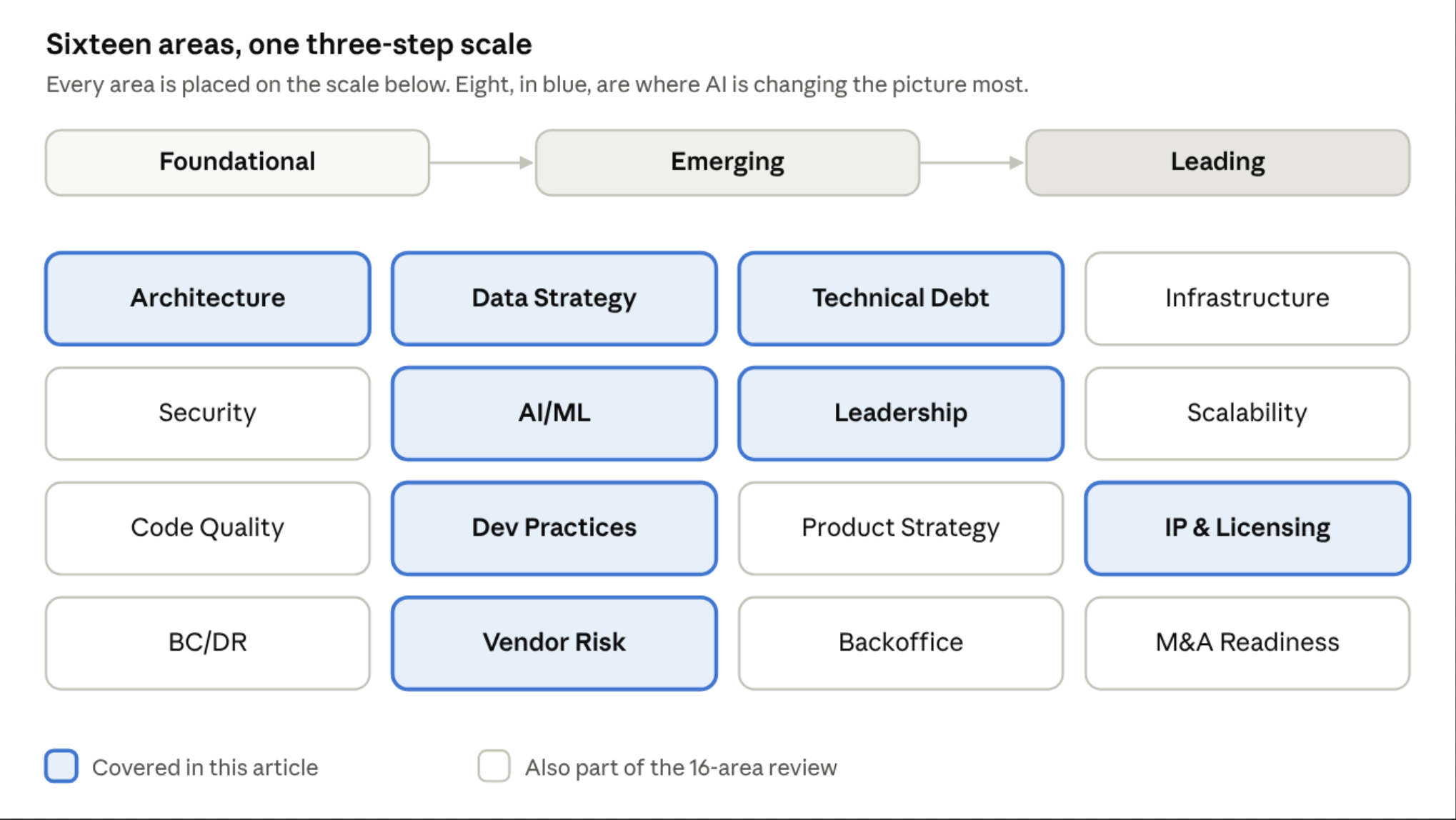
Sixteen areas · three-step maturity scale
Architecture - the pipeline now enforces the design
It is common for system architecture to live in the heads of senior engineers. This is acceptable when people write every line themselves, however it is harder to sustain when agents write much of the code. The rules need to be written down in a form that both machines and people can remain in sync.
This paradigm shift changes both the creation and evolution process considerably. Automated checks, often called fitness functions, become the main architecture artifact. They test dependency direction, module boundaries and key non-functional aspects on every change. Architecture decision records are being rewritten with agents as readers; short, explicit rules with reasons, kept in the repo and paired with policy as code. To cater to an agent-delivered architecture, smaller, modular systems with clear interfaces and good tests are a good fit.
A large tangled codebase that depends on unwritten knowledge is not. And faster change calls for a smaller blast radius, through feature flags, staged rollouts, observability and quick rollback. All of this requires modularity to work effectively and cheaply with constrained context windows.
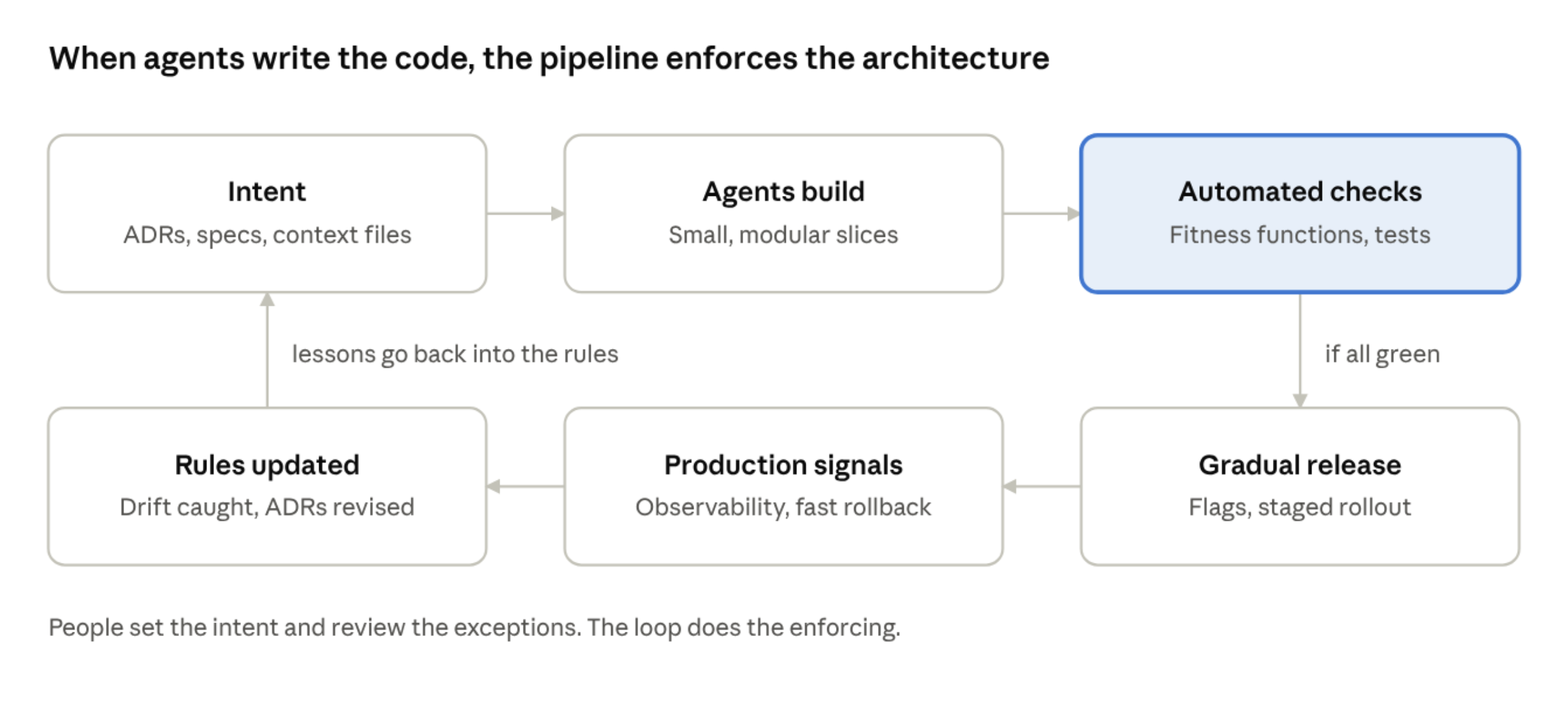
Architecture loop · 6 steps
Two key risks worth focusing on are agents optimize for what 'works now', so without effective guardrails they duplicate logic and wear down boundaries. Comprehension debt is the second one, shipping code that nobody fully understands.
Teams are moving from craft to judgment
Engineering organisations have historically been measured on output - story points, lines shipped, velocity. AI lowers the cost of producing code, so the scarce skill shifts from producing work to judging it. It is about knowing what is worth building, and catching what the model got subtly, confidently wrong.
A useful diligence signal is where senior engineers spend their time. Are they reviewing and setting architectural direction, or are they still heads-down producing, with AI output going to production without a real judgment layer? When velocity outruns review, the result is comprehension debt. It is not a backlog. It is a system no one fully understands, until it shows up as a customer-facing incident. It is crucial for a diligence process to confirm that the engineering mental models have changed , and not only the tools.
New risks that come with AI and ML
AI/ML used to be assessed as a separate stream. Since AI and ML now underpins everyday engineering flow, their risks extend to the deterministic parts of the system too.
There are three areas worth assessing closely,
1. Model and vendor dependency. Choosing a foundation model is a supply chain decision. The models evolve faster than traditional open-source license risk. A provider can change pricing, policy or deprecation cycles, and alter the economics of a feature with no code change on the platform side. This may require constant modelling & tracking of unit cost economics for development of features and other parts of the process.
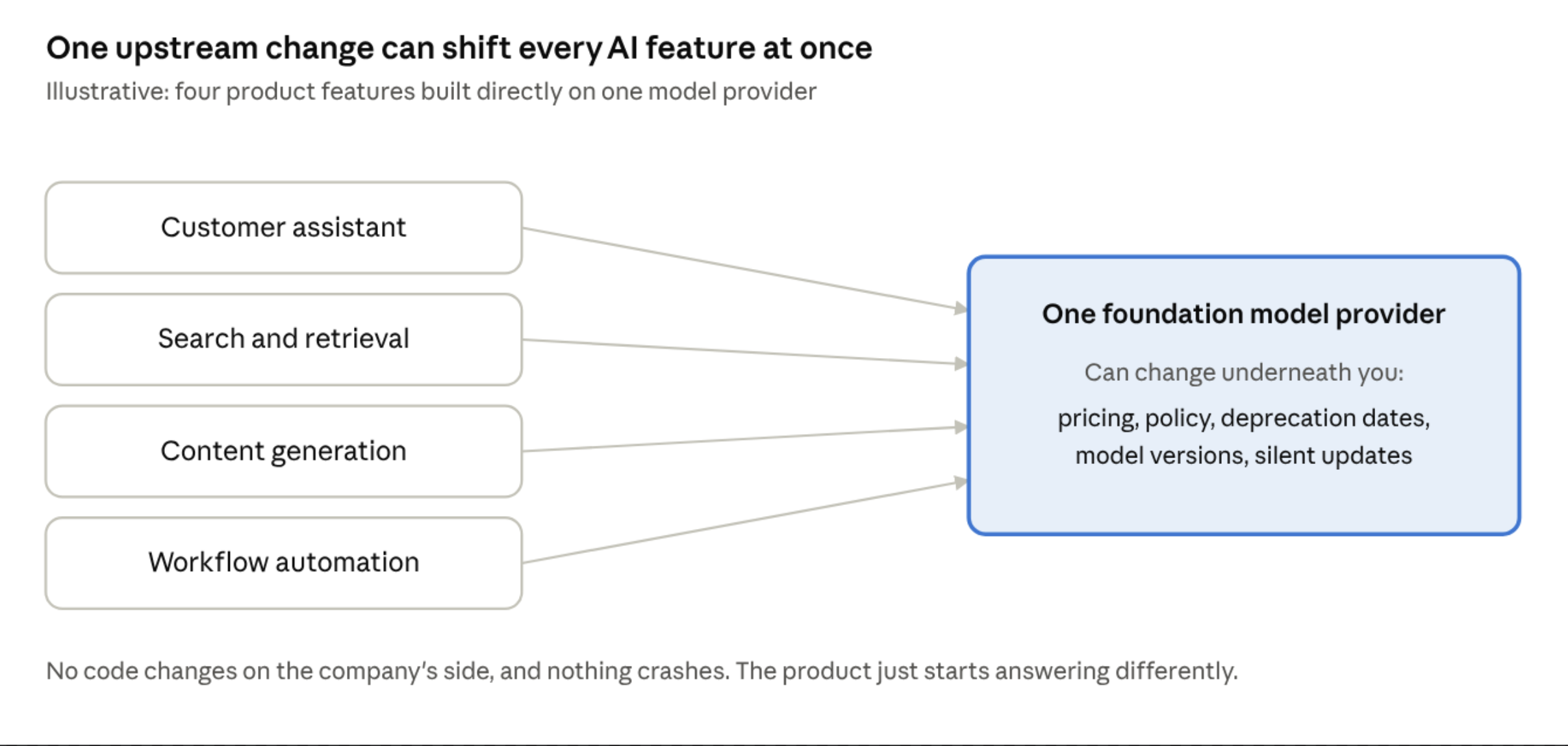
Vendor dependency · illustrative
2. Data and IP provenance. The licensing, consent basis and lineage of the data behind a differentiating model or fine-tune is a common blind spot. It can turn into a legal liability well after closing the deal.
3. Evaluation debt. Without a rigorous evals harness, a team has no way to know that a prompt tweak or a silent model upgrade has degraded output or disrupted the unit economics for an inference. This is a new form of technical debt. It does not throw an error, it just degrades or becomes untenable suddenly.
Technical debt: a real dividend, and a new trap
Diligence has long treated technical debt as a cost problem; flag it, discount the valuation, or size a multi-year remediation budget that might never be fully spent. AI-assisted migration, test generation and large-scale refactoring have changed that math. A legacy migration that took a senior team eighteen months can often be compressed to a fraction of that, with AI handling the mechanical translation and people making the judgment calls. That is an area of real dividend. It should change how known debt remediation should be estimated - short remediation cycles, and an item to conclude in the first 100 days.
But cost compression is not risk compression. A rewrite that is cheap to attempt is not automatically safe to ship. The systems where broad AI-assisted refactoring is most tempting are often also the ones where a silent regression costs the most.
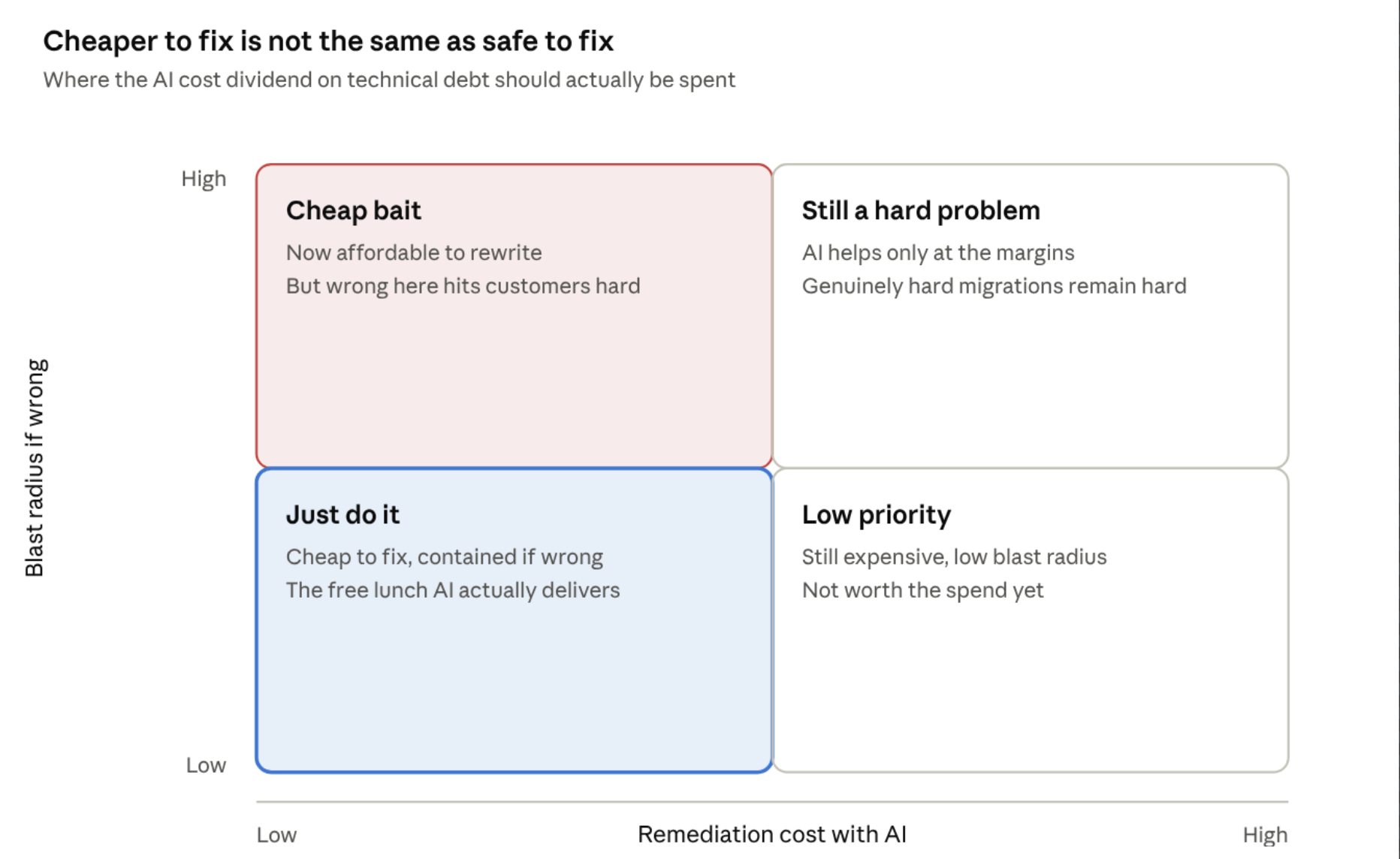
Technical debt · remediation cost vs blast radius
Cheap and contained debt is the place to start. Cheap and dangerous debt needs evals in place before anyone touches it.
Compressing overall risk into exposure and governance
Architecture coupling, product moat, team judgment, vendor dependency and silent failure are multiple lenses on the same two variables; exposure and governance.
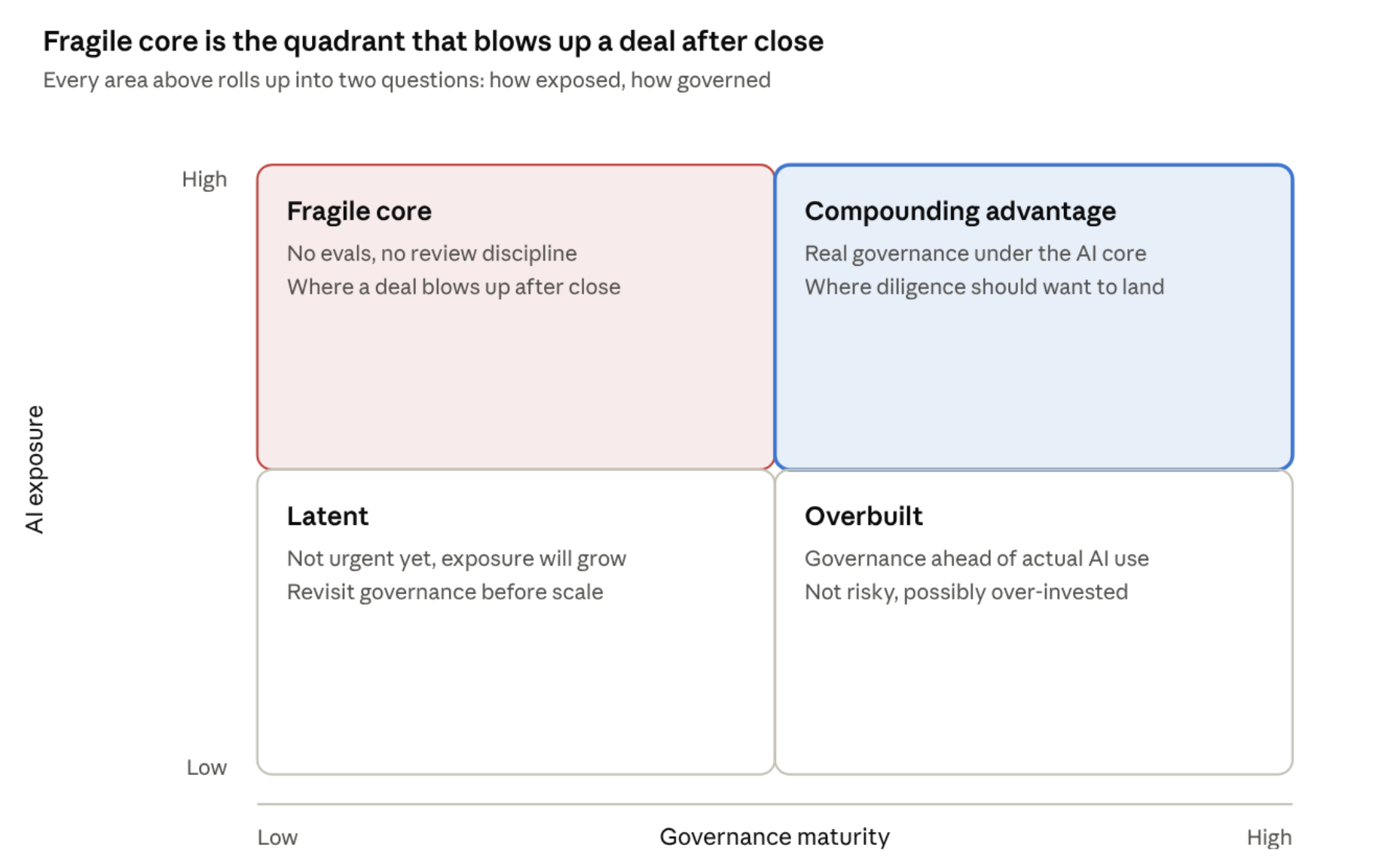
AI exposure vs governance maturity
The first is how much of the value proposition runs through AI. The second is how mature the governance around that AI is. A company can carry a lot of AI exposure safely, and that is the target quadrant. What should concern an investor is exposure without governance, because none of the surface metrics - revenue growth, feature velocity, NPS - will flag it until it is already in front of a customer. Governance maturity now means more than evals and review rigor on new AI features. It also means being able to distinguish cheap-and-safe technical debt from cheap-and-dangerous debt.
What this means for diligence and the first 100 days
1. Score AI governance maturity - evals discipline, vendor diversification, review process - as its own diligence line, separate from general technical debt.
2. In the 100-day plan, fund an evaluation harness before funding more AI feature velocity. Shipping faster on an unmeasured system compounds the wrong metric.
3. Ask technology leadership to name the single model or vendor dependency that would hurt most if it disappeared tomorrow, and price that concentration into the deal.
4. Value AI capability on the balance sheet net of the governance investment needed to make it safe.
5. Before discounting a known pile of technical debt, check whether AI-assisted remediation has already changed its true cost, and separate the cheap-and-safe fixes from the cheap-and-dangerous ones.
This is not an argument against AI.
In fact companies that pair it with real governance are well placed, and good diligence helps them identify, plan and show it. The report records where they stand today. The roadmap shows how far they can go and how risk is mitigated.
AI has inversed the technology risk and it is more crucial than ever to factor it in the diligence process.


