

A data platform assessment should first consider the business plan, then the users, and finally the technology.
"Is our data platform good?" It is the question we are asked most often in technical due diligence or technical assessments, by an investor weighing a deal or by a CTO who has just inherited the platform. A data platform is good or bad relative to what the business needs it to do over the next 12 to 24 months, and to the consumers of data: people reading dashboards, models making predictions, or agents acting on the business's behalf.
The failure we see most often is a platform built well but for the wrong job. A carefully engineered warehouse, tested and documented, designed around the reporting requirements, but both the business needs and technical possibilities have evolved since then. Mature enterprises or data native businesses make data based inferences and decisions in near real time or as frequently as needed.
Understanding the business needs first
Before we open a repository, we ask leadership a few questions. What must data do for the business in the next 12 to 24 months? How does the business intend to use the data or inferences and for what purpose? Who or what consumes it? And what happens commercially if it can't? What are its regulatory, compliance and archival needs?
The answers usually take one of three shapes:
- Reporting-led. The business runs on agreed numbers: board packs, unit economics, returns to a regulator.
- Model-led. The business runs on predictions: pricing, risk, demand, fraud, recommendations.
- Agent-led. The business wants software acting on its data: customer support, operations, internal copilots.
Most businesses are a mix, and the mix shifts. The shape that dominates the next 12 to 24 months decides what the platform has to do. A reporting-led business needs one agreed number for each metric, such as revenue, that everyone accepts. A model-led business needs to reproduce how a model was trained: the same code, data and model version. An agent-led business needs data that a machine can interpret without a person nearby to ask what a column means.
Maturity against need
Figure 1 sets four levels of maturity against the three consumers. Read along a row and you see what people, models or agents experience at each level: how the technology behaves, what users do with it, and what value the business gets back.
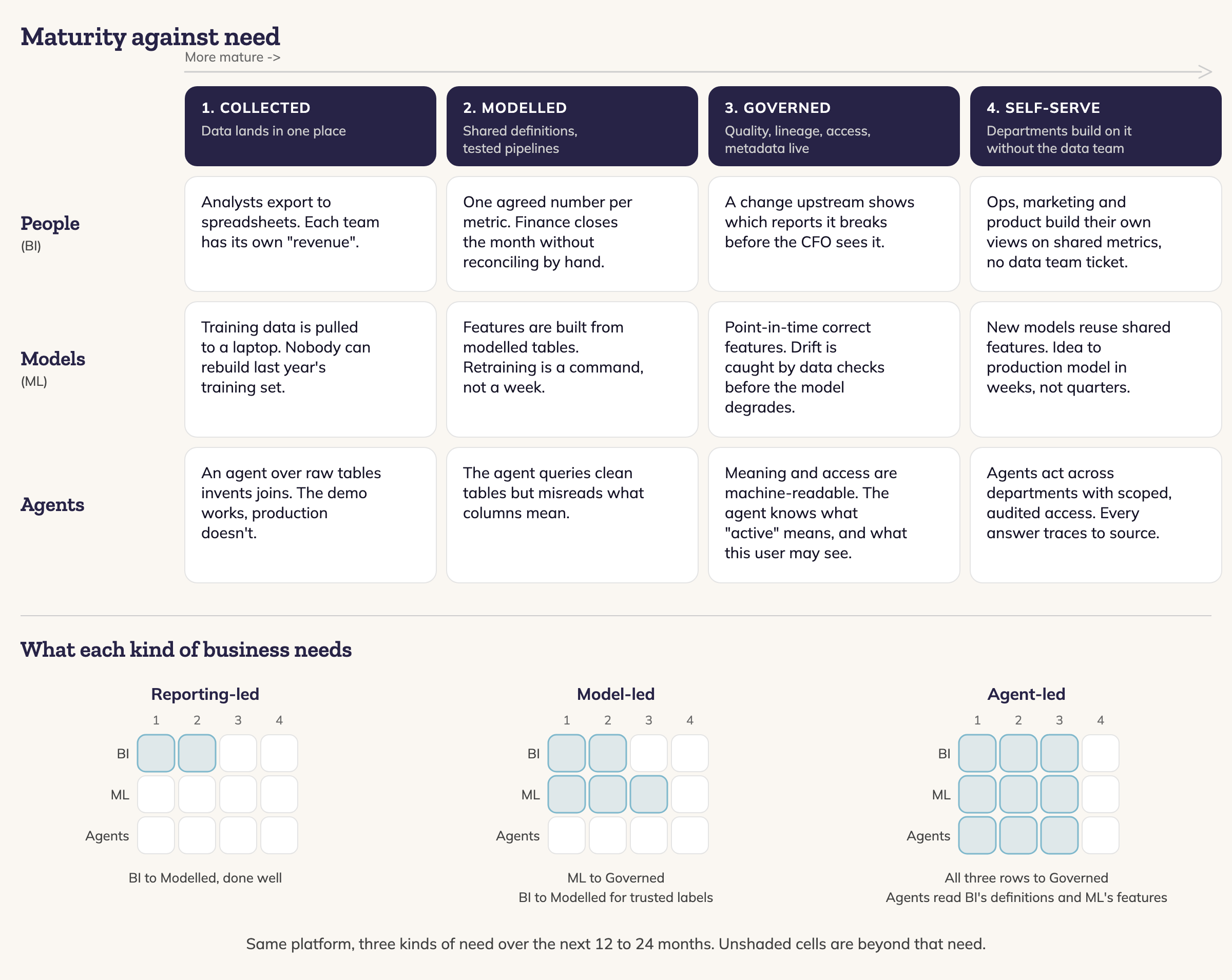
Figure 1. What each consumer experiences at each level of maturity.
The shading shows how far each kind of business need takes the platform over the next 12 to 24 months; unshaded cells are beyond that need.
A reporting-led business can be well served by a platform that has a good data model: agreed definitions, tested pipelines, and a month-end close that finance can run without a reconciliation spreadsheet. Building self-serve or a real-time system ahead of the plan spends money the business will need elsewhere.
A model-led business needs the ML row to reach governed: features that are correct for the moment a prediction was made, and data checks that catch drift before the model degrades. BI can stop at modelled, as long as the labels that models are trained on come from agreed numbers. If the team can't reproduce how a model was trained, nobody can show that a new model beats the old one.
An agent-led business needs more than data prepared for the agent. An agent answers questions from the same metric definitions as the dashboards, and acts on the same model outputs, such as a churn score. So the BI and ML rows need to reach governed as well: definitions with lineage and access controls, and features that are correct for the moment they're used. When a dashboard is wrong, an analyst usually notices. When an agent is wrong, it tells a customer.
We judge whether the architecture allows the next step. A small platform can leave room for governance and machine-readable meaning later, or be built so that the next step means tearing it down. The second is a finding; the first is not.
The plan defines how far the platform has to go and the review then checks how far it has got.
What we look at
Almost every platform we review has the practices on the checklist: tests, a catalogue, a CI pipeline, scheduled jobs. We look at whether each of those practices does its job, and the evidence sits in different places at different levels of maturity.
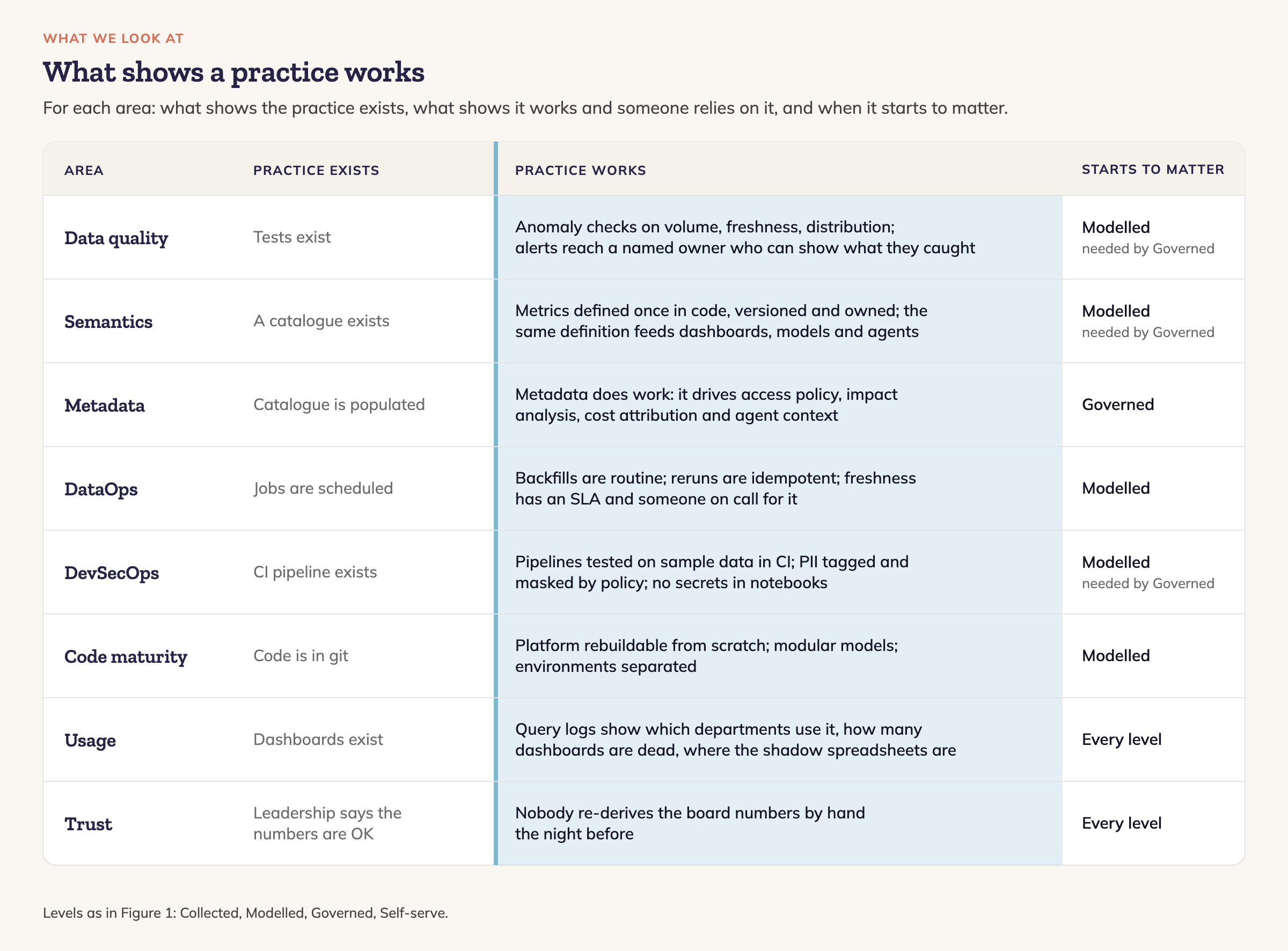
Figure 2. For each area, what shows the practice exists, what shows it works, and the level at which it starts to matter.
Take data quality. A suite of null and uniqueness checks can pass every night on a table that lost a third of its rows on Tuesday. The signal we want is anomaly checks on volume, freshness and distribution (where drift shows up), alerts that reach a named owner, and a history of incidents those checks caught before a user did.
Metadata is similar. A catalogue populated once, for an audit, is stale within a quarter. Metadata is useful when it does work: it drives access policy, tells an engineer what breaks before they change a column, attributes cost to the team that incurs it, and gives an agent the context it needs. The same test applies to DataOps and DevSecOps. We look for backfills that run as a routine job, reruns that are idempotent, and personal data tagged where it enters and masked by policy rather than by convention.
Code maturity is where a platform shows whether it can outlive the people who built it. We ask whether the platform can be rebuilt from scratch in a clean environment, and how long that takes. We look at whether models are small and composable or one long script that only its author changes, and whether a change is tested against sample data in CI before it reaches production.
Two checks apply at every level: whether people use the platform, and whether they trust it. A platform can be built well and still be bypassed, with the real analysis living in the heads of a few people who know which numbers to adjust. We ask who rebuilds the board numbers by hand the night before the meeting. If anyone does, the business doesn't trust the platform, whatever the dashboards say.
Modelling and semantics, layer by layer
When someone rebuilds the board numbers by hand, the cause is usually in how the platform models the business and defines what its numbers mean. We go deepest on this in a review, because it decides whether people, models and agents get the same answer to the same question.
Modelling and semantics runs through every layer of the stack, from how records arrive to how access is granted. A weakness at any layer shows up as a wrong number at the top. Figure 3 shows what we look for at each layer, and what weak looks like.
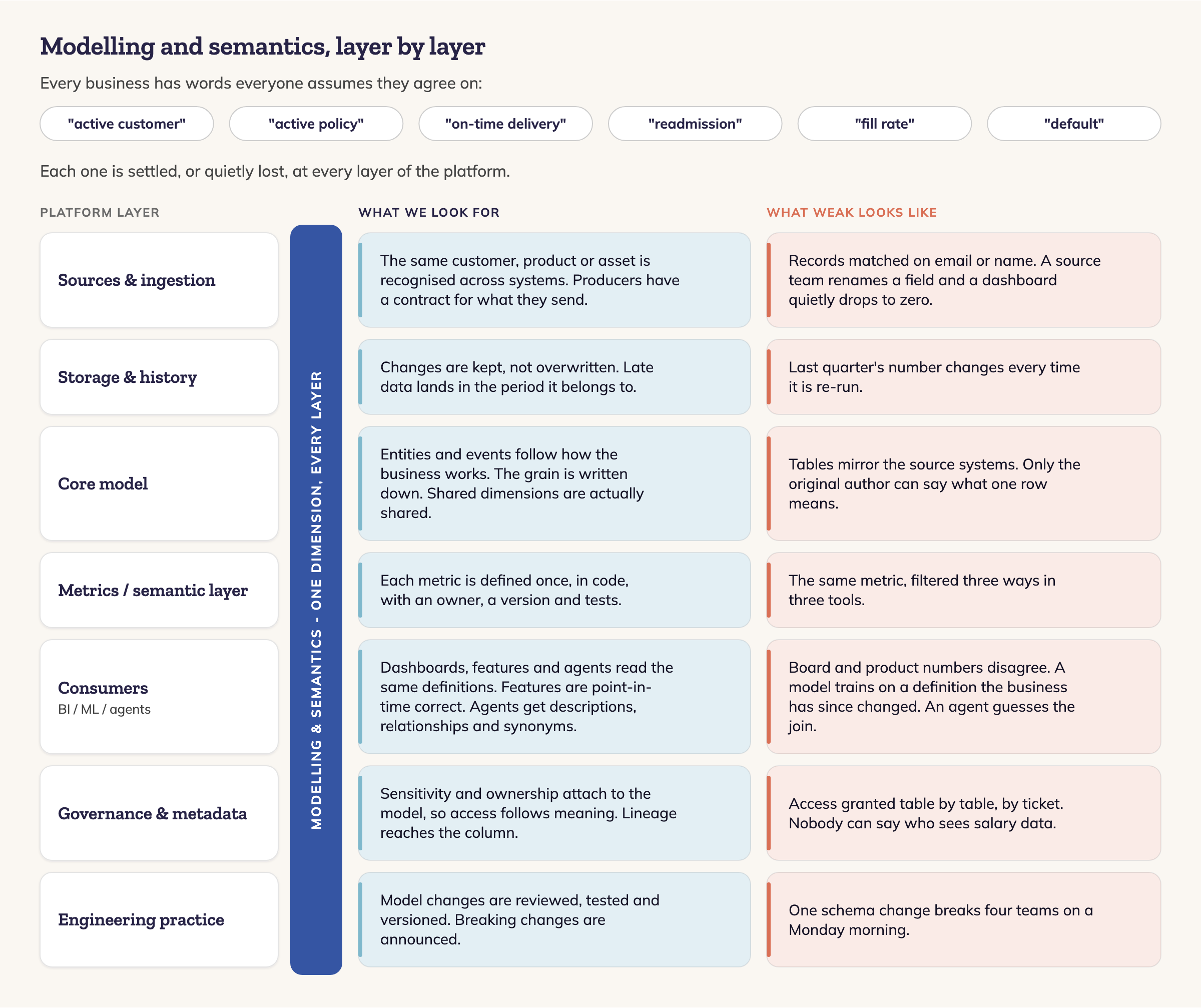
Figure 3. Modelling and semantics at each layer of the platform: what we look for, and what weak looks like.
Follow the stack down and the questions change at each layer. At ingestion, we ask whether the same customer, product or asset is recognised across systems, or matched on an email address. In storage, whether changes are kept or overwritten, since overwriting means last quarter's number moves every time someone re-runs it. In the core model, whether the grain of each table is written down, or known only to the person who built it. In governance, whether sensitivity and ownership attach to the model itself, so that access follows meaning instead of a queue of tickets.
Every domain has words everyone assumes they agree on: active customer, active policy, on-time delivery, readmission, fill rate, default. Ask three teams for one of them and you will often get three definitions, each correct for its own purpose. People cope. They learn which dashboard to believe and ask when they are unsure. A model trained on one definition carries it silently into every prediction it makes. An agent has no one to ask which one you meant. This is the dimension that separates a platform fit for reporting from one fit for agents.
The prioritised roadmap
A review ends with a prioritised roadmap and execution plan. It is set per goal, and one domain can have more than one goal. For each goal, the first item is the one thing that has to be true before any other improvement pays off.
Figure 4 shows 4 example goals. Each pulls in the capabilities it needs, some from governed while the rest of the platform stays at modelled, and each has a different thing to fix first.
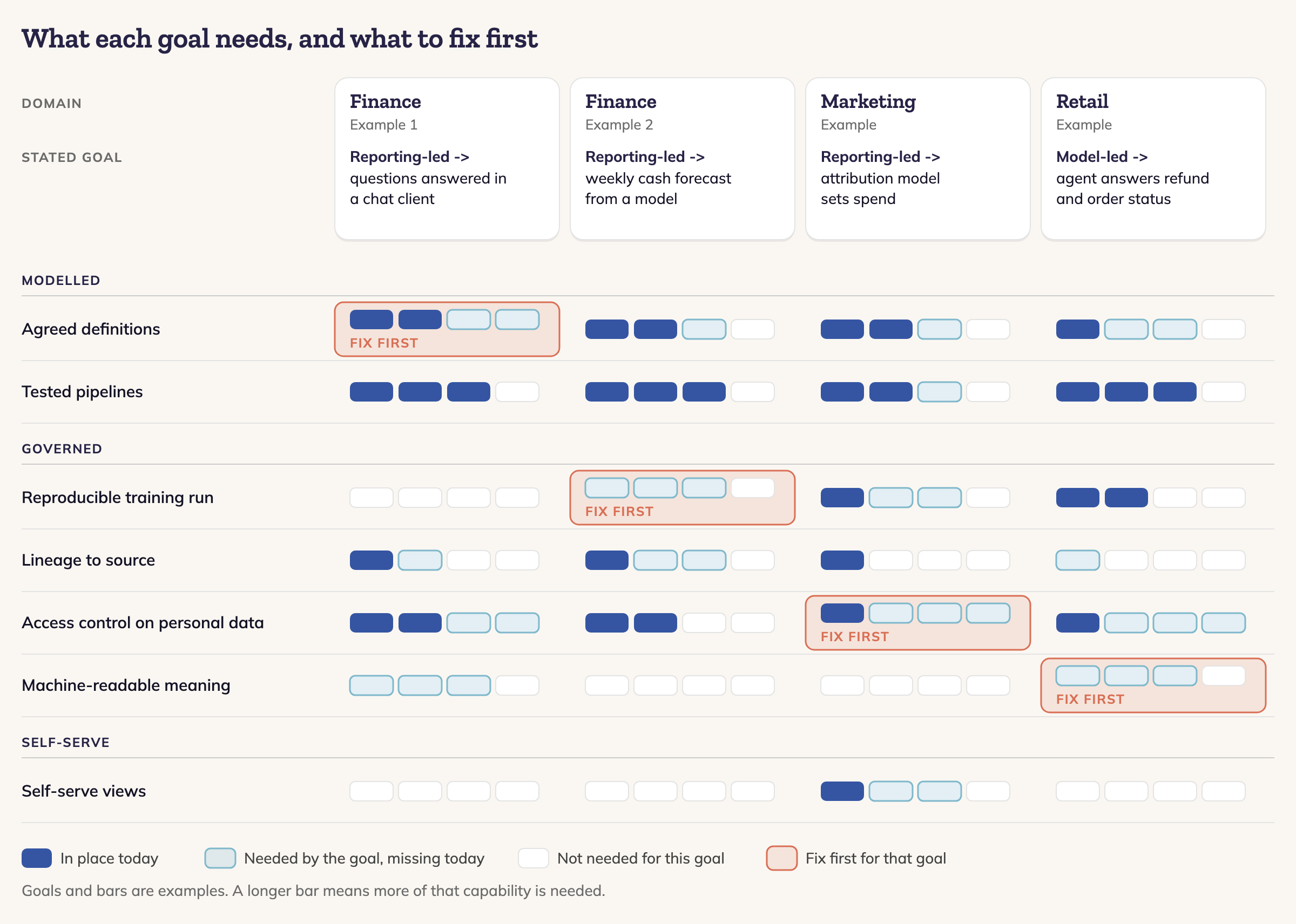
Figure 4. Four example goals, two of them in finance. Each goal pulls in its own capabilities and has a different thing to fix first. Goals and bars are examples.
Finance that wants questions answered in a chat client has to fix agreed definitions first. The same finance team building a weekly cash forecast first needs the infrastructure to reproduce a training run; until it has that, no change to the forecast can be verified. Marketing has to fix access control on personal data before an attribution model can use it. Retail already reproduces its models, so the first fix for its agent is writing down what the data means, in a form a machine can read. Until that exists, the agent can't be put in front of a customer.
Governance goes where a goal needs it. A regulator return needs lineage to source; product telemetry used for experiments may never need it. Raising every domain to the same level spends money where the plan doesn't need it.


