Introduction
Highlights
Relevancy
Preparation
Itinerary

Reliable Delivery at Agent Speed through intelligent Engineering 

Introduction

Expedition in a nut-shell

Everyone talks about coding agents as the breakthrough in software delivery. However, that treats the writing as the constraint. For most organisations it no longer is: agents have removed the limit on how much can be written. What they have not removed is the question of whether anything still guarantees the output is right.

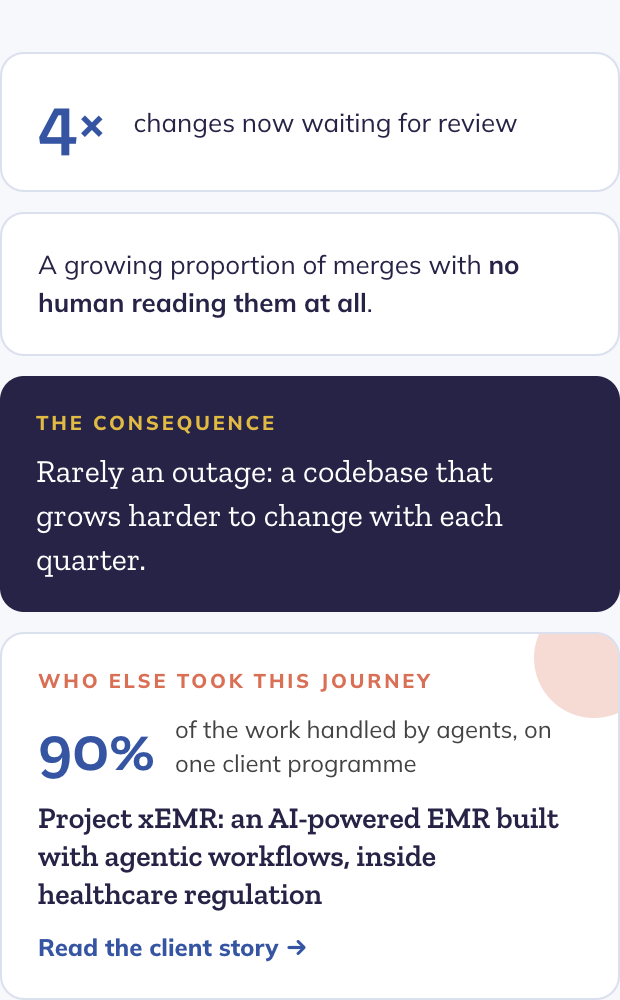
For most of software delivery’s history that guarantee was a human reading the change. It worked because of two conditions that were rarely stated: low volume, meaning changes arrived at a speed at which a person could see all of them, and authorship, meaning somebody had understood the change once and a reviewer could interrogate that reasoning. Agentic workflows removed both conditions simultaneously.

Solving the problem was always the goal; writing code was the craft. Enabling an agent is the craft now.

This reframes the question in front of engineering leadership. Whether to adopt agents has largely been settled by the volume already moving through delivery pipelines. What remains unsettled is what surrounds those agents while they work: the tools, checks and guardrails within which they operate, collectively the harness. Every organisation running agents at scale already has one, whether or not anybody designed it.

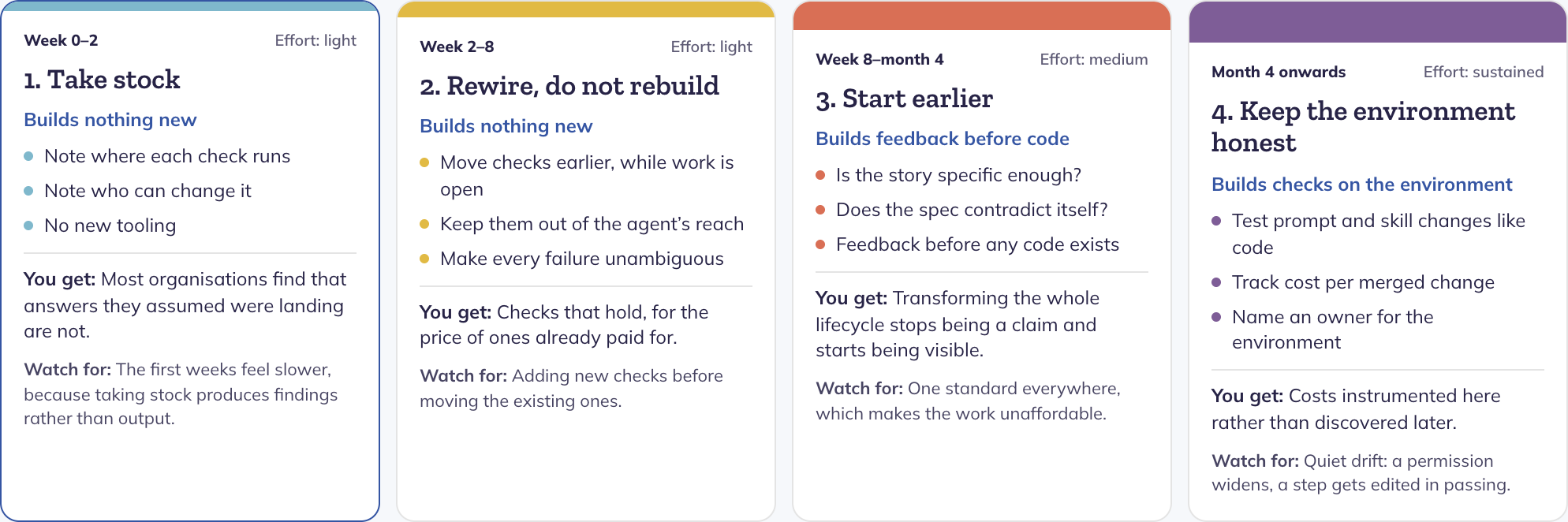
Most organisations have never taken stock of what is in theirs, or how much of it holds. That inventory is where intelligent Engineering starts.
THE iE PRINCIPLES BEHIND THIS VIEW intelligent Engineering →
 AI augments; humans stay accountable
 Context is everything
 Smarter AI needs smarter guardrails
next-slide Highlights

Highlights

What the harness actually contains

previous-slide Introduction
next-slide Relevancy

Relevancy

How would you answer these questions?

What proportion of the changes merged last month was written by an agent? 

Few organisations can answer without going to look, and the inability to answer is itself the first finding. Exposure scales with this number, and in most organisations it has risen for some time without anybody setting a target for it. 

Name a rule the architecture depends on. Now name the check that fails when that rule is broken. 

If the answer is code review, there is no check. Review is an activity, not a mechanism, and its two preconditions have disappeared. 

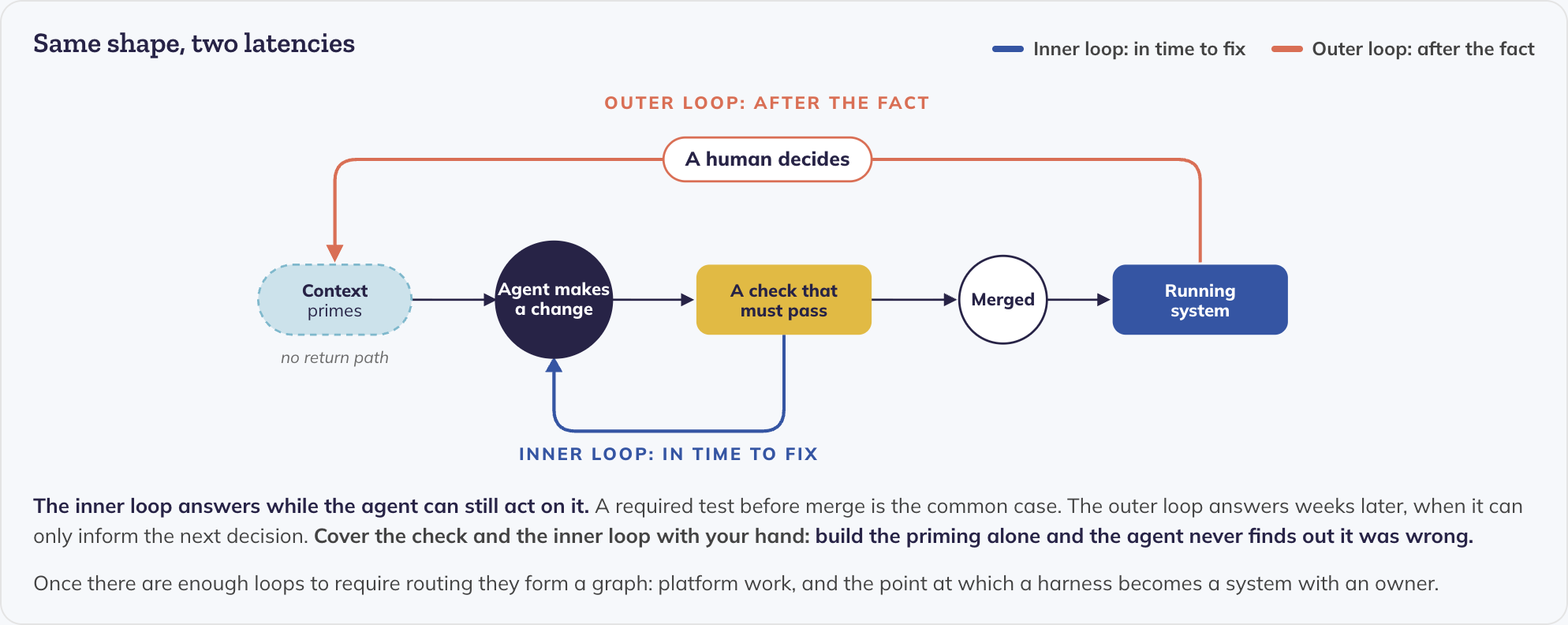
For each check just named, could an agent satisfy it by removing it? A failing test can be deleted. A linter complaint can be suppressed. A pipeline definition can be edited within the branch being pushed.Where the answer is yes, the check records an intention. It does not enforce anything. 

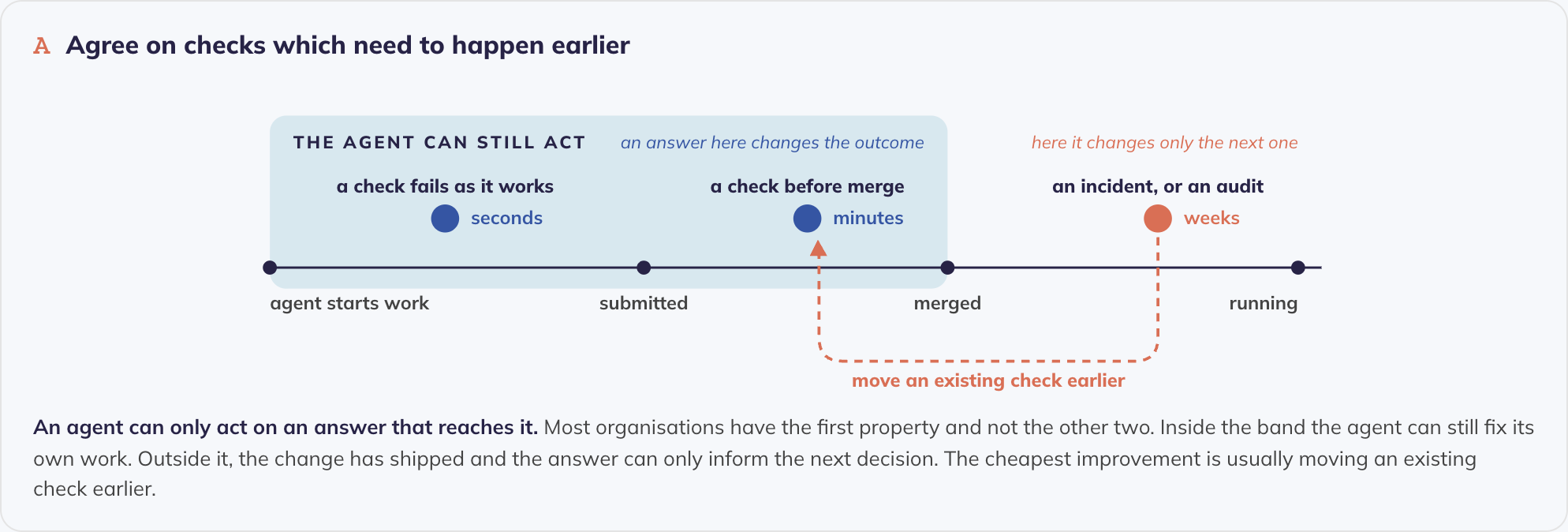
When a change makes the system harder to work on without breaking anything, how long is it before anyone notices? 

This is the latency of the slowest loop in the organisation, and it is usually measured in quarters. Nothing prevents that class of change, so it accumulates. 

If several of those answers are uncomfortable, the harness is doing less than it appears to.That is the common case, and not evidence of a poorly run organisation: the mechanisms that used to cover these questions were adequate until agents changed both the volume and the authorship of the work arriving at them. 

Things to consider 

Exposure is a function of volume rather than intent. A team merging a handful of agent-authored changes each week has the same gaps as one merging hundreds, and considerably more time in which to close them. 

Not every organisation should act on this immediately.Where change volume is low and the system tolerates being wrong for a day, cheap checks and a fast rollback are proportionate, and the structural work can wait. 

The organisations most exposed are not those with no checks.They are those whose checks pass.

previous-slide Highlights
next-slide Preparation
illustration-bg