Executive Summary
Sahaj Software developed a bespoke, unified and connected Manufacturing Execution System (MES) for an industry-leading automotive manufacturer to replace costly and restrictive off-the-shelf products and standardize geographically spread operations. This highly configurable platform, which manages production planning, assembly, and quality assurance in real-time, solved the client’s challenges related to customization, integration, and lack of standardization across multiple plants.
Key Outcomes
Beyond cost savings, the platform provides complete vehicle traceability for regulatory compliance, optimizes production sequencing, and ensures consistent quality and efficiency through standardized workflows across all assembly lines.

The Business Context
Our client is an industry-leading automotive manufacturing company in Asia that manufactures approximately one million vehicles each year. They have manufacturing and assembly lines that are geographically spread across multiple plants in the region. Additionally, each plant is used to manufacture different vehicle models and its variants.
Historically, they used off-the-shelf MES (Manufacturing Execution System) products, however, over time, the cost and effort involved in enhancing and maintaining these products has ballooned.
Moreover, these software products are tightly coupled with deployment, which means:
A lot of time and effort is needed to set up production lines.
Customization needs are unique to each plant, which adds to overall complexity.
Unique needs to make integrating with other systems tricky.
These issues were exacerbated by the lack of enforcement of systems standardization across their plants.
The client collaborated with Sahaj Software to build a bespoke solution: a unified platform which is easy to integrate, highly configurable, scalable and helps standardize the operations across multiple plants.
The following were the key expectations from the new platform:
A configurable system that would support the unique needs of each plant.
Allow for standardized operations flow across multiple plants
Support for asynchronous business operations to ensure the production line doesn’t stop
Provide for real-time-manufacturing-operation tracking and data collection to make informed decisions in a timely manner
Seamlessly integrate with other existing systems to provide holistic insights
Scale as the business scales
Enable quick time-to-market with lower setup cost, and a simple configuration setup for deployment onto the new lines
The Business Challenge
Understanding the complex production planning and execution across various plants was difficult. The existing off-the-shelf systems were restrictive, inconsistent, and often varied from one plant to another, making updates risky and expensive.
System and Standardization Issues
Existing MES products were standard and difficult to customize for specific needs.
Different plants used different software, leading to inconsistent processes across the region.
Operational disruption and high training costs made iterative improvements difficult to implement.
Manufacturing Complexity
The system needed to support multiple vehicle models on a single assembly line.
It had to handle unique requirements for in-house parts like engines, axles, and chassis.
Managing outsourced parts with varying barcode patterns was a challenge during quality checks.
Designing a “vehicle-build recipe” (Bill of Materials) required balancing complex assembly operations and custom sequencing.
Technical and Architecture Requirements
Integration was difficult because the old system lacked event-driven communication capabilities.
The architecture had to support hybrid deployment, splitting services between the cloud and on-premise infrastructure.
Maintaining production line uptime required extreme system resilience and change management with zero downtime.
The Solution
The team at Sahaj developed an enterprise-wide platform that standardizes, manages, and optimizes manufacturing operations across multiple plants. The platform ensures consistent production quality, provides real-time visibility into operations, and boosts overall efficiency.
How the Platform Works
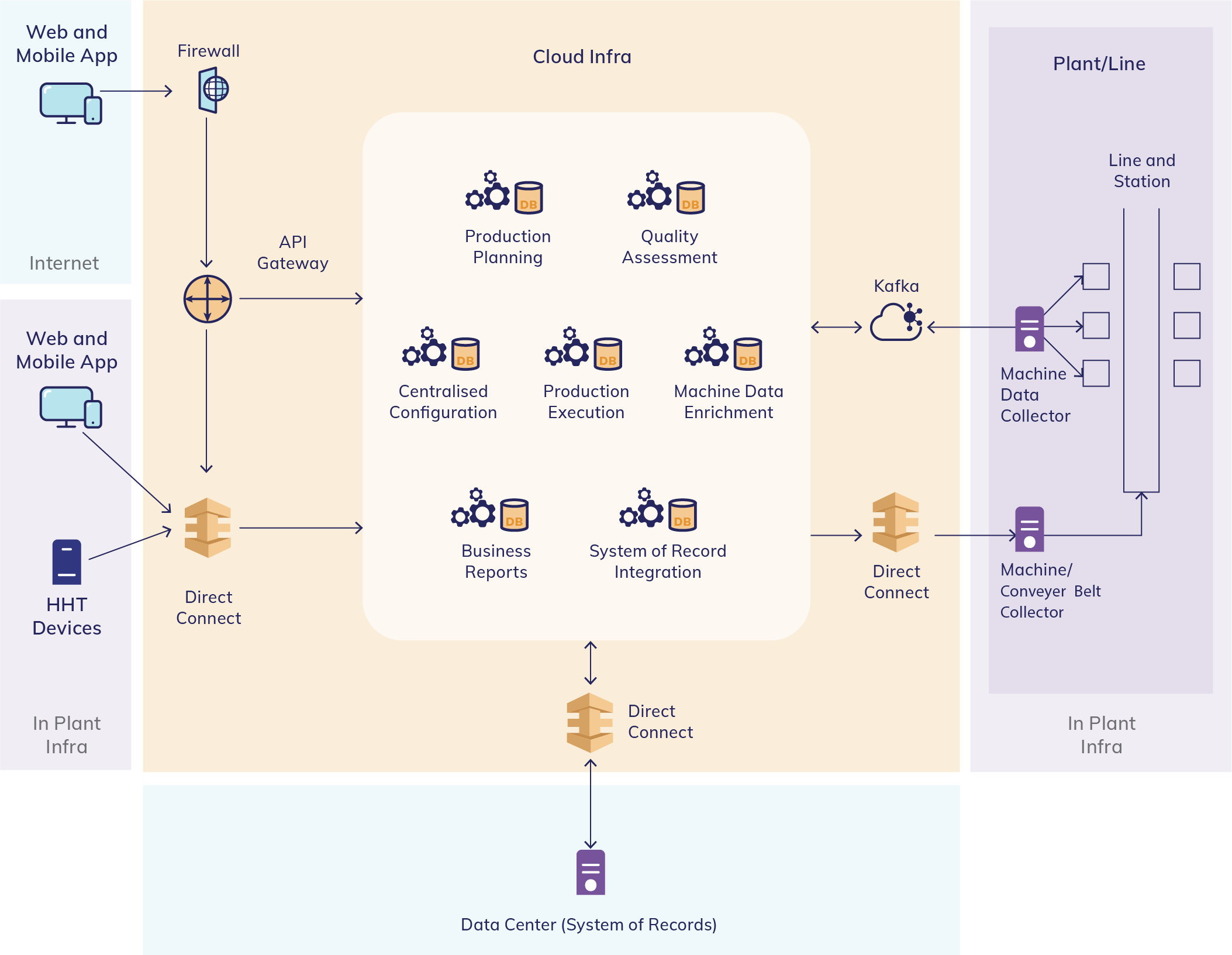
Architecture: Built on a microservices architecture, allowing different services to be developed and deployed independently.
Communication: Utilizes Kafka (an event streaming platform) for smooth, asynchronous communication between microservices, which also generates real-time operational metrics.
Standardization & Scaling: The system supports multiple plants through flexible configurations. New production lines can be set up quickly by updating master data, and the system is designed to scale with each plant’s operations.
Access & Maintenance: The platform supports role-based access control. Sahaj also managed the setup of infrastructure, configuration of tools, and daily maintenance tasks.
Performance & Cost: A data archival strategy routinely moves live data to long-term storage to keep the system performant while managing infrastructure costs.
Below is a high-level functional architecture diagram of the Manufacturing Execution Platform:
System Functionality at a Glance
Production order planning and sequencing
Centralized order planning ensures consistent workflows across plants
Generates optimized production plans using load-level algorithms and configured constraints like workforce, material availability, production line capacity, etc.
Vehicle-level planning drives the production and procurement plans for parts like engines, axles, frames, cabs, etc.
Production assembly of vehicles and parts
Support for a full spectrum of production operations from start (drop) to dispatch (finished goods are ready for sale).
Integration with the system of records to book new inventory (finished goods) and deduct part consumption for the inventory.
Other notable operations include serial-number generation, embossing, part validations against bill of material, tracking of material consumptions at each station, and providing work instructions to operators.
Visual Inspection and defect management to ensure quality gate standards.
Quality management
Quality data is archived in data-lake storage for further analysis.
Support for barcode scanning, error-proofing, part genealogy check, etc. ensuring each vehicle meets stringent quality standards.
Real-time data collection and traceability
Automated data collection throughout the production operation.
Enables real-time visibility of work-in-progress (WIP) and sequencing of parts on the line, thereby enabling vehicle traceability from order start to dispatch.
Ensures complete auditing and traceability for regulatory compliance.
The Impact
Since the rollout of the new unified platform in a few plants across the country, there have been some significant changes observed across the manufacturing and assembly operations. Some of the highlights include:
On average, the overall manufacturing of vehicles increased by 10%.
Reduced the chassis take-out instances, increased the plan vs actual adherence through the visibility of critical parts availability before order start.
Production line setup time reduced from 2-3 months on an average to 2-3 weeks, which had a considerable impact on setup costs.
Reduced the maintenance cost, direct savings on proprietary product licenses.
Because of the infrastructure automation and horizontal scaling capabilities the system support cost is reduced by 30%.
Provided unified real time reports and analytics that has improved the operations visibility and efficiency.
There have been several noticeable improvements in the overall supply-chain flow and part procurement processes, driven by better quality and accuracy in production planning


