
Executive Summary
SiteMinder is the global leader in hotel commerce, with 56,000 hotel customers that use its platform to generate more than AU$85 billion in revenue each year. As a category leader, maintaining its competitive edge was important and so it embarked on a journey of pioneering advanced AI capabilities, including an intelligent “Room Nights Forecasting” engine for its groundbreaking Dynamic Revenue Plus product, which uniquely provides hotels live market intelligence as local demand changes.
The company faced significant bottlenecks upfront:
Firstly, SiteMinder needed to transition complex models from experimental notebooks into an automated global production network.
It was also constrained by its data foundation. The existing warehouse had been built to answer business intelligence (BI) questions, and did that job. However, the data underneath was never modelled for the broader role now being asked of it. Figures across dashboards did not always reconcile, and interpreting them relied on tribal knowledge.
Rebuilding the warehouse on Databricks afforded the opportunity to re-lay that foundation properly, with BI and ML/AI as equal first-class consumers.
To address these hurdles, SiteMinder and Sahaj partnered to co-architect a production-ready Machine-Learning Operations (MLOps) platform on Databricks. By applying intelligent Engineering principles, which entailed AI-assisted internal delivery workflows, the team bridged the gap between innovation and infrastructure.
This collaboration yielded remarkable results, with the initial foundation and model deployed in just 100 days, while subsequent forecasting models were successfully rolled out in under 7 days. It also focused heavily on team enablement, setting SiteMinder’s internal teams on a sustainable path for long-term platform ownership.
Quantitative & Qualitative Impact
Metric / Dimension | Before the Partnership | After the Partnership |
Model Deployment Cycle | Estimated at 3+ months per use case | 100 days for the initial foundation; < 7 days for the next model |
Model Complexity & Overhead | 4,500 theoretical, unmanageable models | Generalizable models covering properties across multiple countries |
Cross-Team Hand-offs | Manual, friction-heavy translation between Data Science and Infrastructure teams | Unified, automated CI/CD and IaC pipeline satisfying both teams |
Operational Reliability | Brittle legacy pipelines; manual drift and error tracking | Automated drift checks with Databricks Dashboards and AI-driven PagerDuty incident triaging |
Data Science Autonomy | Dependent on infrastructure teams for deployment resources | Data scientists ship their own models to production, with no infrastructure queue |
The Client: A Global Hospitality Titan
SiteMinder operates as the vital distribution engine for the global hospitality industry. Headquartered in Sydney, Australia, with operational hubs spanning Manila, Barcelona, London, Dallas, Bangkok, Galway, Mexico City, Berlin, and Pune, the company empowers hoteliers with end-to-end e-commerce capabilities, including the ability to manage room inventory, pricing and bookings, as well as payments and guest communications
Connecting to over 500 Online Travel Agencies (OTAs) like Booking.com, Expedia, and Airbnb, alongside hundreds of Property Management Systems (PMSs), SiteMinder’s massive integration network constitutes an unparalleled market moat. Processing over 140 million reservations annually, SiteMinder acts as an enterprise-grade powerhouse requiring absolute stability, top-tier security, and real-time scalability.
The Challenge: Notebooks vs. Production Infrastructure
Unlike organizations that reactively invest in MLOps following system failures, SiteMinder demonstrated remarkable foresight. To fuel a multi-use-case AI ecosystem, their lean Data Science team developed high-quality room-night forecasting models. However, a massive chasm loomed between a successful local model and global production-grade machine learning.
The engagement inherited three primary constraints:
The Talent Leverage Dilemma: A highly skilled but lean team of just two Data Scientists had to focus on core algorithmic design rather than losing hundreds of hours to manual infrastructure setup.
The “Language” Barrier: Data scientists needed to iterate quickly and change things freely. Infrastructure engineers were accountable for access control, reproducible environments, and a deployment path that would pass an audit. Success would mean working as a single embedded team, where each side understood the other’s constraints and priorities.
Architectural Legacy Debt: The existing warehouse had been stood up at speed to serve reporting, so the model underneath was primarily optimized for BI. As SiteMinder’s ambitions moved from reporting into ML and AI, that foundation required careful modelling of the underlying data.
With a fixed, critical deadline of 6 months to launch its latest feature within Dynamic Revenue Plus, SiteMinder could not afford the typical multi-month timelines of traditional software consultancy firms. They needed an agile, elite engineering partner.
The Solution: Engineering a Unified MLOps Platform
SiteMinder and Sahaj embedded as a unified team in September 2025 with a clear mission: collaboratively work to build an end-to-end, automated MLOps engine on Databricks capable of generating property-level forecasts for SiteMinder’s hotel customers.
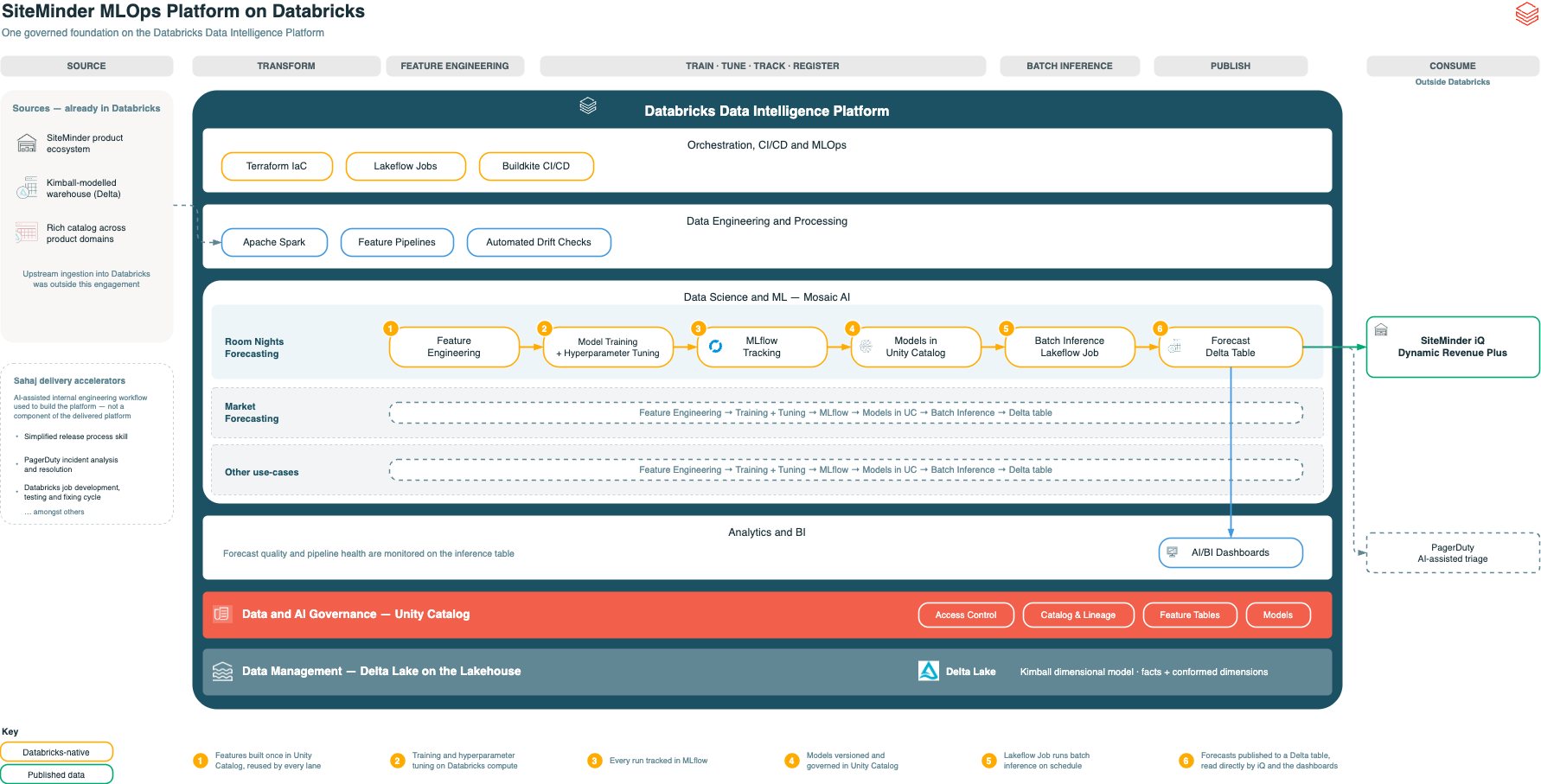
Adopting a culture of rich, high-level discussions aimed at identifying industry best practices and meticulously aligning them with SiteMinder’s systems and architecture, the following solutions were developed:
1. Bridging the Engineering Divide
The team designed an MLOps delivery pipeline that unified the Data Science and Infrastructure & Security teams. A strong culture of collaboration enabled the team to reduce operational overhead by re-architecturing data pipelines. Instead of running 4,500 theoretical models, the team scaled down to 15 highly maintainable, high-impact models which could be expanded to all countries.
2. Infusing intelligent Engineering
Influenced by Sahaj’s foundational principles, the team bypassed generic setups to inject intelligent Engineering directly into how it was delivered:
Custom Claude Agents: Domain-specific AI assistants equipped with specialized skills distilled complex architectural design discussions, built and tested ML models and simplified deployments to environments.
Automated Diagnostics: These agents actively investigate incidents by autonomously analyzing logs, and code artifacts, minimizing debugging loops and maintaining high system availability.
3. Rebuilding the Data Foundation
The existing warehouse had been modelled for reporting alone, so the definitions behind key business numbers lived inside individual dashboard queries and varied between different stakeholders. Sahaj and SiteMinder’s data team rebuilt the foundation in Databricks and moved those definitions into the data model itself. The single shared definition was now usable across dashboards and AI use-cases.
4. Baking in Stability and Governance
Rather than treating security, infrastructure, and feature engineering as an afterthought, they were built in from the start. Every dataset and model has a known owner, a traceable lineage, and an enforced access policy before it reaches production. In practice this means SiteMinder’s data scientists can put a new model live without queuing for a security review, and the business can trace any forecast back to the data it came from.
5. Team Scaling
A critical objective of the engagement was ensuring that the platform’s evolution didn’t stop when the initial project concluded. Sahaj acted not just as an engineering arm, but as an enablement partner.
Throughout the co-delivery process, Sahaj worked side-by-side with SiteMinder’s engineers to transition modern infrastructure practices directly into the data team’s daily workflow. Furthermore, Sahaj played an instrumental role in helping establish and upskill SiteMinder’s growing data team in Pune, anchoring best practices and setting them on the right path to independently scale and advance their global AI capabilities.
The Impact
In just 100 days, Sahaj and SiteMinder built a production-grade blueprint and rolled out the first forecasting model. Because the foundational architecture was so robustly engineered, the second predictive model was fully deployed to production in less than 7 days.
Today, SiteMinder’s AI ecosystem operates at peak maturity:
Autonomy & Empowerment: SiteMinder’s data scientists now work confidently with enterprise tools like Terraform, Databricks, and specialized CLI applications, owning their products from “code to production” without infrastructure bottlenecks.
Resilience at Scale: Automated drift checks, visualized through Databricks Dashboards, regularly validate predictions, ensuring continuous model accuracy across varying market dynamics without requiring manual intervention.
Business Velocity: SiteMinder’s “Room Nights Forecasting” is now live for properties in multiple countries.
Through this partnership, SiteMinder successfully protected its market-leading position, converting cutting-edge data science theory into a scalable, revenue-driving global reality.
Partnering with Sahaj has been a game changer for SiteMinder’s strategic data capability. The quality of the team has been consistently high and a joy to work with. Together we’ve built the next generation of our data platform, data pipelines and ML models — all of which are critical elements of our AI strategy. The team has also played an instrumental role in helping establish our data team in Pune, which is now well placed to continue advancing our data capability.
— Tomas Varsavsky, Chief Technology Officer, SiteMinder


