
Sixteen dollars a policy
In one of the recent Tech DDs I was part of, for a digital insurer in Southeast Asia, the most important number in the report was not really about code. It was a simple division.
On day one, the business team told us pricing was their edge, faster and sharper than anyone else in the market. Then we asked the obvious question: what does the technology cost to run? Over four million dollars a year, across roughly 250,000 policies. That is about sixteen dollars of technology for every policy on the books.
Now, the platform itself was not bad at all. It was scalable, reliable and well documented. But it cost more than the business could comfortably carry, and much of that cost would grow with every policy sold. And here is the interesting part: one of the biggest licences was for the pricing engine, the very thing the company said made it different. It was rented, by the year.
Years earlier, I had seen the mirror image of this in a Tech DD for a distribution start-up in East Africa. They had built things they could easily have bought, and left the data that could have set them apart mostly unused. So in some sense, one company rented its edge, and the other spent its effort everywhere except its edge.
Our Tech DD approach asks a basic question: is the technology an asset or a cost? Honestly, you can't answer that from code alone. You need to know what it costs against the business, and what the company actually owns. In our eight areas, this sits mostly under Infrastructure & Cloud.
Measure cost against the business
A total bill on its own doesn't tell you much. So we divide it by the unit of business, whether that is a policy, an order or an active customer, and compare it with what that unit earns.
Then comes the more important question: how does that number move as the business grows?
Most growth plans carry an underlying assumption that the platform gets cheaper per unit as volume goes up. At the insurer, several of the biggest costs grew in step with the business. So growth alone was never going to bring the sixteen dollars down.
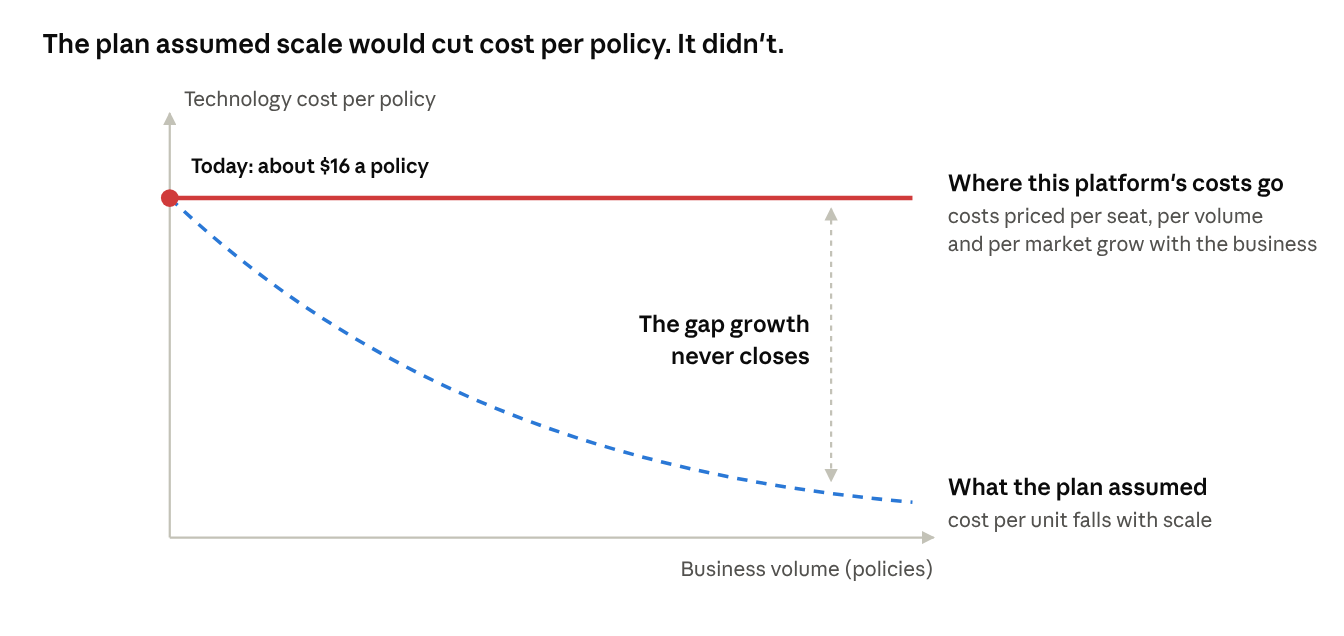
Cost per policy as the business grows · illustrative, not to scale
Build where you compete, buy where you don't
Every platform is a mix of what a company built and what it bought. Neither is good or bad by itself. The question is whether the company owns the parts that make it different, and rents the parts that don't. Interestingly, two Tech DDs I was part of, years apart, got this wrong in opposite directions.
Built what it could have bought. The start-up supplied small neighbourhood shops with stock and credit. Its real edge was its network and its relationships with shop owners. Yet the engineering team had built their own ERP, and even their own app store. Meanwhile, the database had rich data on orders, visits, deliveries and credit, which the product barely used. When we listed the opportunities, almost all of them were about that data: repeat-order suggestions, credit scoring, smarter vehicle loading, fraud detection.
Bought what it should have built. The insurer was the opposite. Its edge was pricing, but pricing ran on a licensed engine. That made it harder to do the one thing that would deepen the edge, which is training models on its own pricing and claims history. Its core workflows, from quotes to claims, were built inside a CRM platform and set up separately for each country. Our recommendation was to bring pricing and the core workflows in-house, and then build pricing, fraud and retention models on top of that.
So what we do is ask the business, not the technology team, what makes the company different. Then we trace that answer into the platform and ask a simple question: who owns this part?
Own what makes you different. Rent the rest, and keep checking the rent.
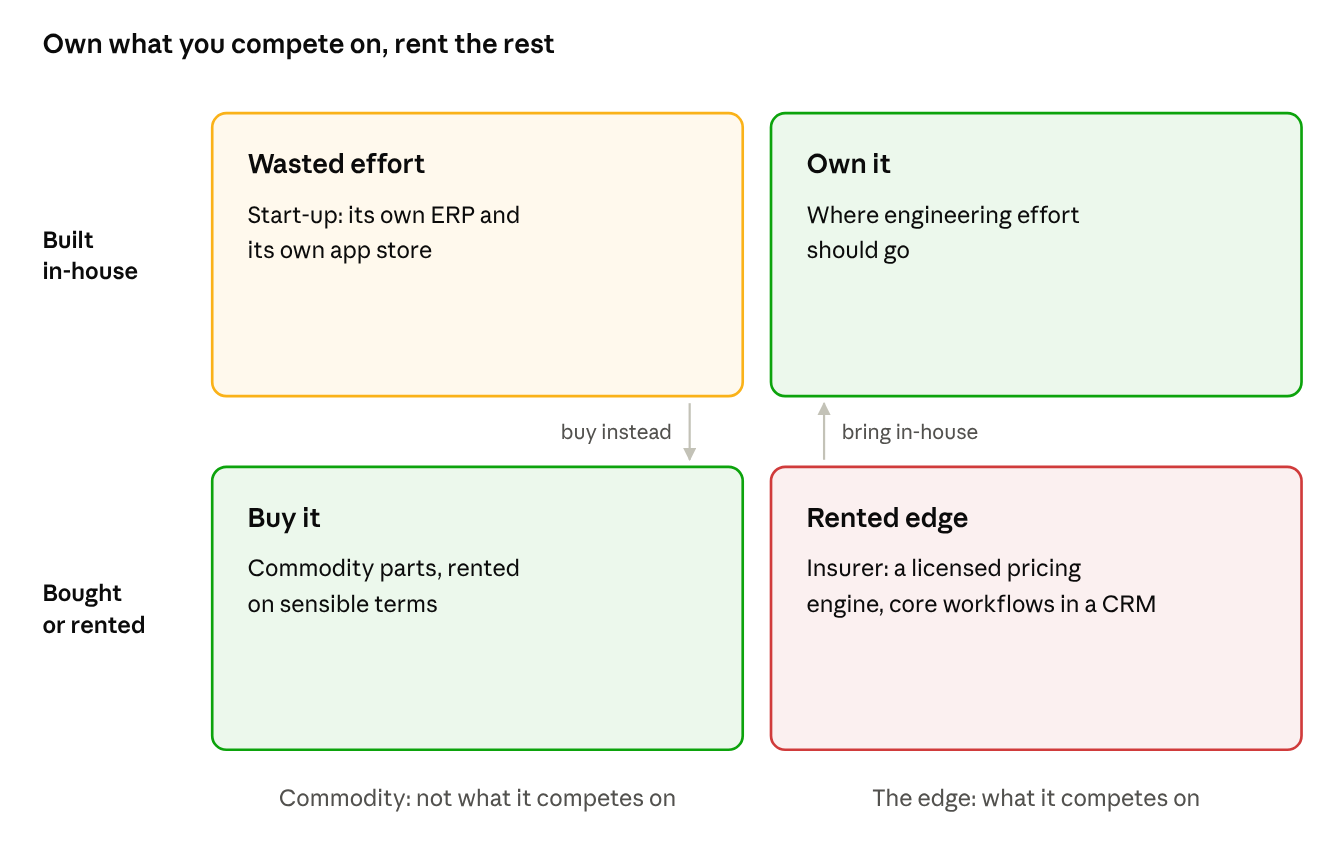
Build vs Buy · where each company sat
Both companies sat in the wrong half of the picture, from opposite sides. The fix in each case was to move effort toward the top right.
How cost multiplies, and why buying was right once
Runaway cost rarely comes from one big decision. It builds up from many small, sensible ones. At the insurer, the services were written to be generic, yet each country had its own deployment, web apps, mobile apps and CRM setup. The platform also ran on three cloud providers, each chosen for a good reason at the time. At the end of the day, every new market added one more set of things to run and pay for.
The start-up did the opposite: one deployment for every country, with no way to scale or release for one market alone. Neither extreme is the right answer. What the investor really needs to know is what each new market costs, and whether that number is going up or down.
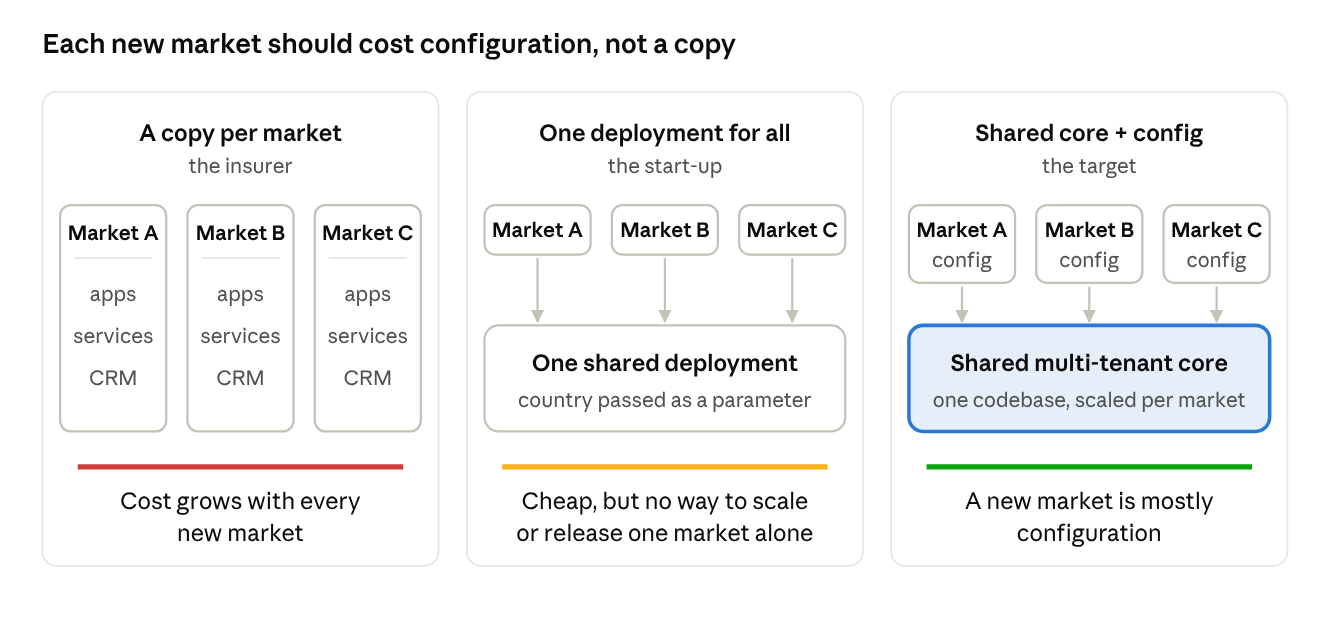
Serving many markets · three patterns
Now, none of this makes the original choices wrong. Buying got the insurer to market fast, and that speed was worth the licence fees. As our report put it, the platform "started with 3rd party components for faster time to market, but as the product evolved and scaled, the same were not refactored." So the choice was not the problem. Never going back and revisiting it was.
I have been guilty of judging too fast myself. Looking back at my notes from the start-up, I had called their cloud provider "not the best" and their app store "hacky", without really asking what those choices saved a start-up on a tight budget. Now, before judging, I try to answer a few questions retrospectively: what did this choice give the business at the time, has the trade-off flipped since, and does the team know that?
What we check, and what we hand back
We ask in business terms, not technical ones. For example:
• If volumes doubled next year, which lines of the bill would double too?
• What would launching a new market/geography cost?
• Which part of the platform would a competitor most want to copy, and who owns it?
• If your key vendor doubled its price, what would you do?
Then we check whether the paperwork backs it up, because a statement is not proof. That means twelve months of cloud and software invoices against business volumes, licence contracts and what they are priced on, the deployment layout by market, and vendor data terms.
What we hand back is a costed roadmap, not a list of complaints. For the insurer, the cost and ownership items came to roughly a million dollars of one-off work. That included a deployment strategy across markets, replacing the pricing engine, and moving workflows out of the CRM platform. Against that was around half a million dollars a year in licences, and a platform that otherwise got more expensive with every policy and every market. So the investor could weigh that trade directly against the business plan.
To conclude
Code quality is where a Tech DD starts, not where it ends. Reading the code tells you whether a platform is well built. But it doesn't tell you whether the business can afford it as it grows, what each new market will really cost, or whether the company actually owns what it sells. And honestly, those are the answers that move valuation, and you won't find them in the code alone.
The insurer's platform was well built, yet it cost sixteen dollars a policy and rented its edge. The start-up owned things it didn't need to, and left its real advantage, its data, largely untapped. Both were fixable. Both were worth knowing before the deal.
That is what this area of a Tech DD is really for: to clarify whether the technology drives long-term value or acts as an ongoing liability, and what it will take to bridge the two when they are not in sync.


