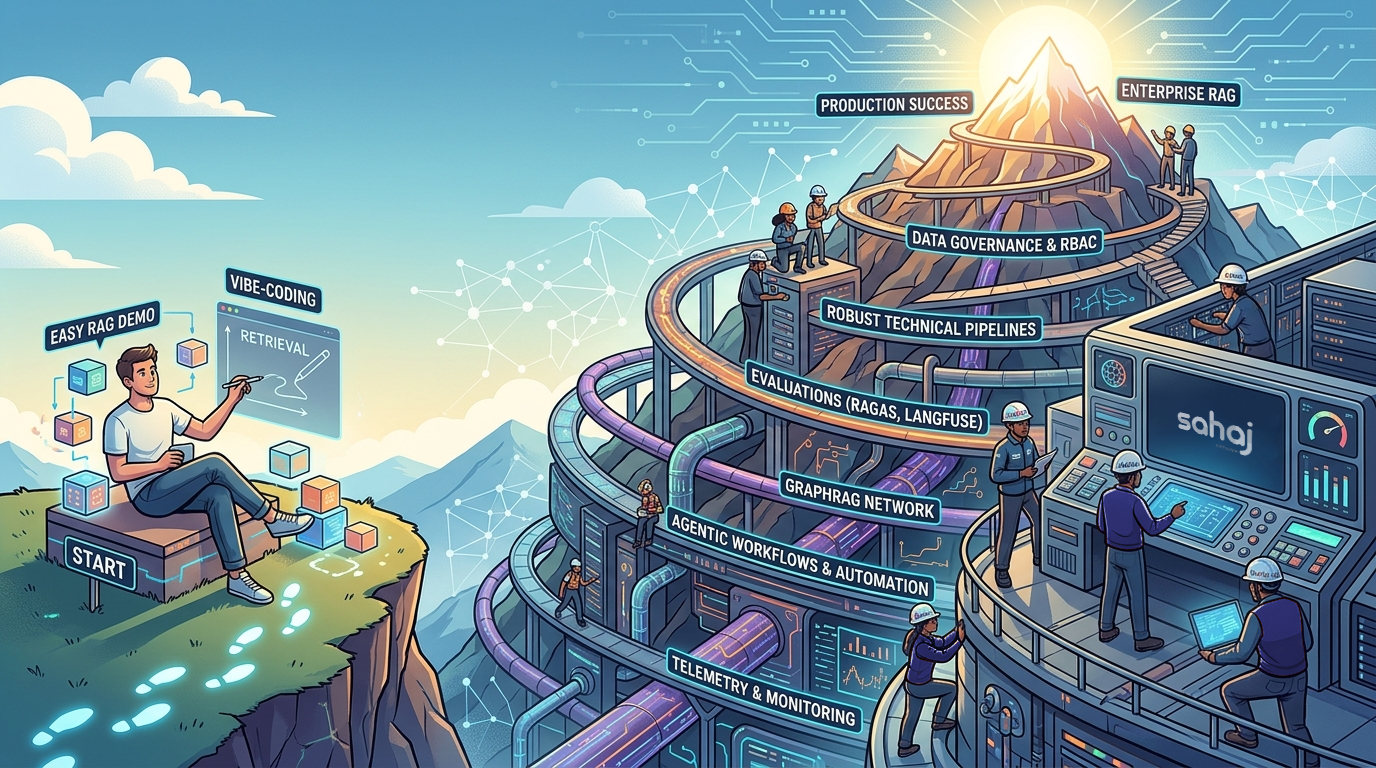
We’ve all seen the dopamine hit of the "magic" AI demo. In the current landscape, it has never been easier to build a system that feels like the future in thirty minutes. We have officially entered the era of vibe-coding—the practice of using AI-assisted, rapid prototyping to assemble compelling applications that secure client buy-in and validate use cases.
This is particularly true for Retrieval-Augmented Generation (RAG) systems. RAG is the essential process of grounding Large Language Models (LLMs) in data they were never trained on — whether that's your proprietary information or anything that has happened since the training cutoff. It relies on three core steps: ingestion (converting documents into vectors), retrieval (finding relevant data for a query), and generation (synthesising an accurate answer based only on that context).
But the "reality check" for 2026 is blunt: vibe-coding gets you the contract, but it doesn't get you a product. Any architect who has survived a production rollout knows that a demo is simply a promise that engineering eventually has to keep. Today, the distance between a successful query prototype and a robust, enterprise-grade system is growing, not shrinking.
The Defence of RAG: Why Context Windows Aren't Enough
The emergence of LLMs with 1M+ token context windows led some to predict the death of RAG. Proponents argued that the difficulty of finding information across disparate chunks had been solved by simply stuffing the entire dataset into the prompt.
However, this represents a fundamental misunderstanding of enterprise scale. RAG remains the dominant pattern in 2026 for three critical reasons:
- Dataset Scale: Enterprise data exists at the Terabyte/Petabyte scale. No context window, regardless of size, can accommodate an entire corporate data lake.
- Context Rot: As context grows, signal is diluted and attention mechanisms degrade in non-uniform ways. Recent benchmarks (Chroma [1], NoLiMa [2]) show frontier models losing more than half their accuracy well before their advertised context limits — a structural limitation of the transformer architecture, not a quirk of any single model generation.
- Token Usage & Cost: Passing whole documents for every minor query is an architectural failure of cost-efficiency. Targeted retrieval is, and will remain, the only way to manage the bottom line.
Commoditisation vs. Custom Engineering: The Spectrum of Solutions
Since the technique was formalised in a 2020 paper [3], enterprise RAG truly took off around 2022-2023 alongside the advent of ChatGPT and the generative AI boom. In those early days, RAG projects were highly experimental, custom-built use cases requiring significant manual effort. The RAG landscape has matured rapidly. Today, organisations can choose from a rich spectrum of out-of-the-box solutions. Choosing the right architecture is a strategic manoeuvre, balancing seamless data integration against strict privacy and control. Organisations typically choose from:
- Ecosystem "Copilots" (Microsoft 365, Google Workspace Gemini, Amazon Q): The fastest path to value if you heavily rely on a major tech ecosystem, offering immediate, native grounding within your existing workflows and document permissions.
- Managed Enterprise Search (e.g., Glean, Sinequa, Coveo, Elastic, Lucidworks): A maturing category offering strong out-of-the-box connectivity across corporate data silos, with access control inheritance as a core feature. Vendors vary significantly in AI-nativity, pricing, and regional support — making evaluation essential rather than optional.
- Managed Cloud Services (GCP Vertex AI, Azure AI Search, AWS Kendra): Robust, off-the-shelf infrastructure ideal for engineering teams wanting to build custom AI applications without managing the underlying search primitives.
- Low-Code Builders (e.g., Dify.ai, Flowise): Perfect for rapid, visually-driven deployments that still offer flexibility and control over model selection.
- Private & Local Search (e.g., Danswer, PrivateGPT): Essential for high-privacy, air-gapped, or departmental requirements where data sovereignty is the absolute priority.
Moving toward self-hosted and local instances massively increases data sovereignty but carries a heavy tax in engineering overhead and maintenance.
The Triggers for Custom Engineering
Custom RAG becomes a strict requirement when "off-the-shelf" solutions reach their limits, whether that limit is technical capability, compliance, or cost. There are five specific triggers that force an organisation into the path of custom building:
- Complex Data Structures: High-stakes sectors like Finance and Legal require custom parsing.
- Multi-Hop Reasoning: When an answer requires synthesising facts across unconnected documents.
- Agentic Workflows: When the AI must "do" (execute SQL, trigger webhooks) rather than just "read".
- Cost Optimisation: The need for semantic caching and targeted query routing.
- Strict Compliance: Defence or Healthcare needs that mandate air-gapped, on-prem solutions.
The "Vibe-Coding" Trap
Vibe-coding is strategically brilliant for idea validation, allowing teams to mock advanced functionality—like embedding charts in a chatbot—and test basic features. For example, tools like Google AI Studio can turn prompts into full-stack apps with complex UI elements, Firebase backends, and direct Cloud Run deployment. We have successfully used this to demonstrate capabilities to potential clients.
However, this creates a dangerous false sense of security. Because these prototypes look highly polished and appear "as good as the final product," stakeholders severely underestimate the technical debt being accrued.
The Harsh Reality of Production
If your strategy ends at the demo, you aren't building a product; you're building an expensive liability. Moving from a flashy proof-of-concept to a reliable, secure production system is fraught with complexity. Vibe-coding fundamentally ignores the structural pillars of production engineering, including:
- Data Governance: A robust architecture must integrate with Identity Providers to enforce Role Based Access Control (RBAC)/Attribute Based Access Control (ABAC) and dynamic filtering. Engineering teams must proactively protect proprietary data with end-to-end encryption and handle PII responsibly through automated redaction and anonymisation before information reaches the model.
- Robust Technical Pipelines: Front-end query intelligence requires user intention recognition and dynamic query transformation. Backend retrieval intelligence relies on optimised chunking, fine-tuned embeddings, and sophisticated re-ranking to ensure only the highest-quality data is surfaced.
- Evaluations & Telemetry: You must move from qualitative "vibes" to rigorous, metric-driven frameworks. Continuous evaluation requires tools like Ragas and TruLens to quantify context relevance and answer faithfulness. Furthermore, robust telemetry tools like Langfuse or Arize Phoenix are mandatory for tracking live latency, monitoring token consumption, and debugging agent workflows in production.
Advanced Solutions: Proving It in the Real World
As enterprise architectures mature, developers are pushing beyond traditional vector search to advanced strategies like GraphRAG and Agentic RAG. These directly address two of the custom-engineering triggers identified above: multi-hop reasoning and agentic workflows. Sahaj has extensive experience building and deploying both, proving that these complex technical hurdles can be successfully navigated:
Mapping Complex Relationships with GraphRAG: Standard vector search often loses relational context. GraphRAG solves this by integrating knowledge graphs that extract entities and relationships during ingestion. Sahaj developed an economic mobility program assistant utilising GraphRAG to map complex relationships between individual user profiles, localised mobility metrics, and national data sources. This interconnected structure uncovers deeper insights, delivering context-aware, evidence-based, and fully explainable recommendations that trace directly back to the source data.
Driving Action with Agentic RAG: Agentic RAG transforms AI pipelines from passive "readers" into active "doers" that dynamically reason and execute complex workflows. For an automotive manufacturer, Sahaj deployed an agentic system serving truck owners, fleet managers, and parts sellers. These intelligent agents execute active workflows, including performing database queries for parts, making live API calls for vehicle tracking, and generating custom data visualisations. This setup autonomously bridges the gap between knowledge retrieval and actionable business intelligence.
Conclusion: The Path Forward
2026 is the year the AI industry grows up. We are moving past the era of simply being impressed by AI that talks, toward demanding AI that works within the rigours of enterprise governance. The path forward requires a disciplined transition from vibe-coding to rigorous engineering—incorporating data lineage, sophisticated retrieval, and automated evaluation.
The question for your team is no longer "Can we build a RAG demo?" But rather: Is your RAG system built on a foundation of robust engineering, or is it still just surviving on a vibe?
[1] Hong, K., Troynikov, A., & Huber, J. (2025). Context Rot: How Increasing Input Tokens Impacts LLM Performance. Chroma Research. https://www.trychroma.com/research/context-rot
[2] Modarressi, A., Deilamsalehy, H., Dernoncourt, F., et al. (2025). NoLiMa: Long-Context Evaluation Beyond Literal Matching. arXiv. https://doi.org/10.48550/arxiv.2502.05167
[3] Lewis, P., Perez, E., Piktus, A., et al. (2020). Retrieval-Augmented Generation for Knowledge-Intensive NLP Tasks. arXiv. https://doi.org/10.48550/arxiv.2005.11401


